19-09-2026
What is Cloaking in SEO?
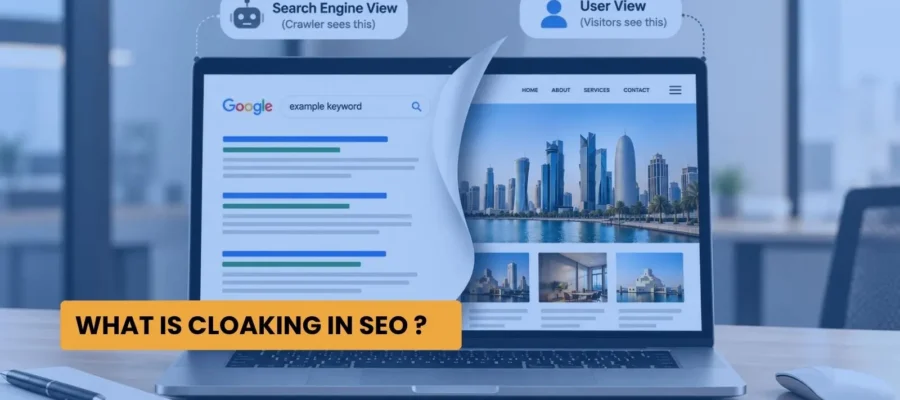
Almost nobody researching cloaking is planning to try it.
They are checking something else. A quiet worry that sits behind the question, usually phrased as: our site wouldn’t be doing this, would it? Somebody set up a redirect two years ago. Somebody installed a security plugin last spring. Nobody has looked since. And because the penalty for cloaking arrives without a warning email first, that worry is a reasonable one to act on. It is also the reason this page is written the way it is, because anyone buying SEO services in Qatar needs the accidental version explained far more than the deliberate one.
The short answer: Cloaking means serving search engines one version of a page while human visitors get a different one, in order to manipulate rankings. Google classes it as a spam policy violation. Pages can be pushed down hard or dropped from the index, with a manual action applied on top after human review.
What does Google actually say about cloaking?
Google’s spam policies describe it as presenting different content to users and to search engines with the intent to manipulate rankings and mislead people. The illustrations Google chooses are deliberately unsubtle. One is a page that feeds travel content to the crawler and something completely unrelated to whoever clicks. Another is keywords injected into a page only when a search engine asks for it.
Now look at the word intent, sitting in the middle of that definition.
It is the most reassuring word in the sentence and the most misleading. Intent defines the offence. It plays almost no part in how the offence gets detected.
Why anyone ever did this
The logic was sound once, which is what made it popular.
A crawler in 2008 read text. It did not see layout, did not run much JavaScript, did not experience a page the way a person did. So a site could hand the crawler a dense block of relevant terminology and hand the customer a clean page with an offer and a button, and appear to serve both perfectly. Two audiences, two formats, one URL. Very tidy.
Then rendering caught up. Search engines began comparing what they fetched against what a browser actually produced, and the trick stopped being clever. What remains is mostly operators working on domains they expect to lose anyway, which tells you how the economics landed.
What happens when Google catches it
Two mechanisms, and they are separate.
The first is automated. Systems detect the mismatch, rankings collapse or the pages leave the index, and no human at Google ever looks at the site. This can happen quietly enough that the first sign is a traffic graph.
The second is a manual action, applied after human review and visible in Google Search Console. It sits there until the underlying problem is fixed and a reconsideration request is accepted.
That second path is the expensive one. Repairing the technical cause is usually a day of work for a competent developer. Getting the visibility back afterwards is a different timeline entirely, measured in weeks or months, with no guarantee attached. For a business whose enquiries arrive through organic search, the gap between the fix and the recovery is the part that actually costs money.
How sites cloak by accident
Here is where the real exposure sits for ordinary companies, and most guides on this topic skip it entirely.
Nobody makes a decision to deceive anyone. A configuration is set for a sensible reason, and a crawler ends up on the wrong side of it.
- Location-based redirects. Visitors from different countries get routed to different pages. Googlebot crawls predominantly from United States addresses, so it receives a version nobody on the team has ever looked at.
- Forced language switching. A site that redirects automatically on browser language can hand the crawler a page no human visitor from your market ever reaches.
- JavaScript rendering gaps. Content that only appears once scripts execute will be missing if anything interrupts execution for the crawler. Browser looks fine. Fetched page is close to empty.
- Aggressive bot filtering. Firewalls, CDNs and security plugins often serve something stripped down to traffic that looks automated. Crawlers look automated.
- Stale cache and staging rules. A rule written to serve cached output to particular user agents will happily outlive the reason it was written, and nobody reads those files for fun.
Five ordinary configuration choices. Not one of them made by someone trying to game a search engine.
Why bilingual sites in Doha run into this more
Because bilingual is the norm here rather than the exception.
Most serious business websites in Qatar carry English and Arabic, and how the switch between them is built decides whether there is a problem at all. Automatic redirection based on IP address or browser language turns up in local audits more than any other cause, which is why a digital marketing company in Doha tends to check it before anything else.
The remedy is architectural and dull. Each language version gets its own crawlable URL. The versions are connected with hreflang. Visitors pick, rather than having the site pick for them. Once that is in place, a crawler requesting a URL receives precisely what a person requesting the same URL receives, and the entire category of risk disappears.
Sites serving one language in one market almost never trip this. It is close to a regional speciality.
What is not cloaking
A lot of legitimate work varies content between visitors, and none of it is a problem.
Personalisation driven by past behaviour. A/B testing with canonicals handled properly. Geo-targeting that offers a regional version instead of imposing one. Paywalls declared through structured data. Anything sitting behind a login.
The distinction is narrower than people assume and worth stating precisely: the question is not whether your pages differ between visitors. It is whether search engine crawlers are being singled out for a version that human visitors never receive at that address.
One footnote that causes confusion. Google used to suggest dynamic rendering, where crawlers were served a pre-rendered version of JavaScript-heavy pages. It was never classified as cloaking. It was always described as a workaround, and Google has since withdrawn the recommendation in favour of server-side rendering or static output.
Checking your own site
Everything here depends on seeing what Google sees rather than what your browser draws.
Open Google Search Console and run URL Inspection on your most commercially important pages, comparing the rendered HTML against the page in front of you. Fetch those same pages as Googlebot and look for missing sections, unexpected redirects or blocked resources. Then repeat the exercise through a VPN from outside Qatar, because location rules only reveal themselves from somewhere else. Read your firewall, CDN and security plugin configuration for anything that treats automated traffic as a separate class of visitor. And check each language version independently, since that is reliably where the surprises are.
Material difference between the crawler’s version and the visitor’s version is a problem to fix. How it got there is a question for afterwards.
Getting this right
Nobody needs a debate about whether cloaking is a viable tactic in 2026. It is not.
The conversation worth having is narrower and considerably more useful: is your site producing something that resembles cloaking, through a redirect rule or a rendering gap nobody has examined since launch? On a bilingual site, the odds are higher than most teams expect, and the check takes an afternoon.
Bragyst provides SEO services in Qatar for businesses that need search to generate actual enquiries, including the technical audit work that surfaces problems like this before a traffic drop does it for you.
Get in touch and we will show you what Google is seeing on your site.
Blogs

10 Critical Signs Your WordPress Site Is Hacked in 2026 (And What to Do About It)

Zero-Click Search: Strategies for Getting Visibility When Clicks Are Declining

Organic vs Paid Marketing: Which Is Better for Your Business in 2026?

AI Content vs Human Content: What Ranks Better in 2026?