21-08-2026
AI Content vs Human Content: What Ranks Better in 2026?
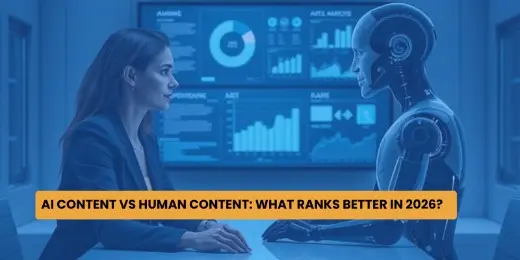
There are two large-scale studies from this year that appear to contradict each other completely.
Ahrefs analysed 600,000 top-20 ranking pages and found that 86.5% contained at least some AI-generated content, with the correlation between how much AI a page used and where it ranked coming in at 0.011. Effectively zero. AI involvement had no measurable relationship with ranking position.
Semrush looked at the same question and found human-written pages were eight times more likely to hold the number one position.
Both are credible. Both are probably right. And understanding why they don’t actually conflict is the most useful thing a business in Qatar can take from this debate.
Why Both Findings Are True
Ahrefs measured across all of the top 20 positions. Semrush measured position one specifically.
That distinction explains everything. AI-assisted content ranks perfectly well across the first two pages of results. It shows up, it competes, it holds positions. What it struggles to do is take the top spot on competitive queries, because the top spot is usually decided by something AI can’t manufacture: genuine expertise, original data, direct experience, a point of view that isn’t derivable from what’s already been published.
So the honest answer to “does AI content rank” is yes. The honest answer to “does AI content win competitive queries” is usually not on its own.
What Google Actually Says
Google’s position has been consistent and public. Danny Sullivan has repeatedly clarified that Google does not rank content based on whether it was produced by a human or a machine. There is no AI detection step in the ranking process.
What Google evaluates is whether content is helpful, original, accurate, and satisfies what the person searching actually wanted. Content produced with AI assistance meets those standards or it doesn’t, exactly like content produced without it.
The failure mode Google does penalise is scaled content abuse: publishing large volumes of automated content primarily to manipulate rankings rather than to help anyone. That’s a use case, not a technology.
The Practical Evidence
Grokipedia is the clearest recent example of what happens at the extreme end. Launched in October 2025 with over 885,000 AI-generated articles, it gained real search visibility initially. Google’s March 2026 core update removed most of it. It also lost visibility in AI Overviews. Pure scaled AI publication without human insight didn’t hold.
At the other end, Rankability ran a controlled test on a competitive commercial keyword, found their AI-generated content underperforming, replaced it with content from a human writer, and saw results improve. Their broader study of 487 articles found Google’s systems somewhat favouring human-written content on commercial queries.
Meanwhile, 86.5% of pages ranking in the top 20 contain some AI content, and 87% of SEO teams keep humans heavily involved in content production. The market has largely settled on hybrid.
What This Means for Businesses in Qatar
Here’s the part that matters more than the studies.
Qatar’s search landscape is thinner than larger markets. A handful of businesses compete for any given commercial query. “Best logistics company in Qatar.” “Office fit out Doha.” “Corporate lawyer Qatar.” The competitive set is small enough that the gap between position one and position four is decided by a narrow margin.
That margin is almost always something specific to the business. A real client situation described in enough detail to be useful. Local market knowledge that only comes from operating here. A number from your own operations. An opinion about how something works in this market that contradicts the generic advice.
None of that is available to a model generating content about Qatar from general training data. It comes from the business.
So the practical framework isn’t AI versus human. It’s what AI does well versus what only the business can supply.
AI handles research synthesis, structure, first drafts, meta descriptions, variations, and the volume work that would otherwise consume a week. Humans supply the market knowledge, the client examples, the specific numbers, the editorial judgement about what’s actually true, and the point of view.
Content that has both ranks. Content missing the second half competes for position eight.
A Note on AI Detection Tools
Businesses spend a surprising amount of energy trying to get content below a threshold on tools like ZeroGPT or Originality.ai.
Worth knowing: Google doesn’t use these tools. There’s no AI detection step in the ranking process. And the detectors themselves are widely documented as inconsistent, misclassifying human-written content as AI and vice versa, which is why Search Engine Land flagged that limitation in its own coverage of the Semrush study.
That doesn’t make them useless. If content reads as generic and templated enough to score high on a detector, that’s often a signal it’s also thin on the specifics that actually differentiate it. But the score is a proxy, and a rough one. The real question is whether the content contains anything a competitor couldn’t have written.
Optimising for a detection score is optimising for the proxy. Adding genuine expertise, original examples, and market-specific detail fixes both.
What Good Content Operations Look Like in 2026
The businesses in Qatar getting real results from content aren’t the ones publishing most, and they aren’t the ones refusing to use AI.
They’re the ones with a clear view of what their content needs to accomplish commercially, a process that uses AI for speed on the parts where speed matters, and genuine human input on the parts that determine whether anyone finds the content worth reading.
Fact-checking is non-negotiable. AI-generated statistics, citations, and specific claims need verification before publication, because hallucinated details in published content damage credibility with both readers and search engines.
Bragyst builds content and SEO strategies for businesses in Qatar around exactly this: using AI where it genuinely accelerates the work, and building in the market knowledge and specificity that decides whether content ranks or just exists.
If your content is being produced consistently but not moving anything commercially, the gap is usually somewhere in that second half.
Blogs

App Development in Qatar: 7 Benefits That Actually Pay Off
Performance Marketing Qatar: Why Google Ads Localization Fails
What is Cloaking in SEO?

10 Critical Signs Your WordPress Site Is Hacked in 2026 (And What to Do About It)