11-07-2026
Local SEO Services in Qatar: How to Rank Your Business on “Near Me” Searches
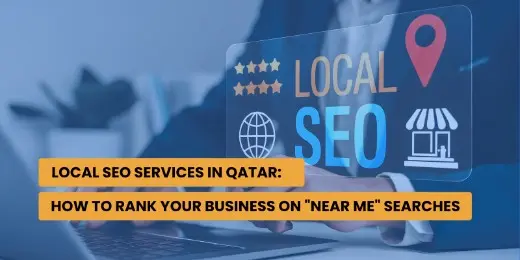
Someone in West Bay types “accountant near me” into Google at 11am on a Tuesday. Your firm is three minutes away. You’ve been operating for four years, you have good clients, your work is solid. And your name doesn’t appear anywhere in the results.
That’s the local SEO problem in Qatar. Not a lack of quality or reputation, a lack of visibility at exactly the moment a potential client is looking.
(46% of all Google searches carry local intent, and 76% of those local searches result in a store visit within 24 hours.) That’s not a stat about a distant market. That’s what’s happening on phones across Doha, Lusail, The Pearl, Al Wakrah, every day. The businesses that show up in those results aren’t necessarily better. They just have their local SEO in order.
What “Near Me” Actually Means in Qatar’s Market
Qatar has a search landscape that doesn’t behave like anywhere else, and most generic local SEO advice misses this entirely.
Over 80% of searches in Qatar happen on mobile. The population is roughly 85-88% expatriate, meaning searches happen in English, Arabic, Tagalog, Hindi, Malayalam, and a dozen other languages depending on who’s searching. A procurement officer at Qatar Energy searching “industrial supplier Doha” at 10am is a different person with different intent than a Qatari resident searching “مطعم لبناني في الدوحة” at 7pm. Both are local searches. Both have high intent. Neither is served by the same piece of content.
The Arabic search angle is the one most businesses in Qatar genuinely haven’t addressed. (Arabic internet content represents less than 3% of all online content globally, despite Arabic being spoken by over 420 million people.) In Qatar specifically, (Arabic search queries for services like healthcare, legal consultation, accounting, and education have grown by an estimated 18 to 22% year over year.) The competition for those Arabic search results is thin. A business that invests in genuine Arabic local SEO, not Google-translated content dropped into a poorly structured page, but actual Arabic keyword research and native-quality content, is competing in a space where most competitors haven’t shown up yet.
What Google Is Actually Evaluating for Local Results
When someone searches “restaurant near me” in Doha, Google isn’t just looking at websites. It’s running a three-factor assessment: proximity (how physically close the business is to the searcher), relevance (how well the business matches what was searched for), and prominence (how credible and active the business appears online). The third factor is the one most businesses neglect and the one most within their control.
Prominence is built through a combination of things that have to work together. A properly completed and actively managed Google Business Profile, consistent business information across every directory and platform where the business is listed, a genuine volume of recent reviews, and a website that loads fast enough on mobile not to cause people to bounce before it finishes rendering. (Google’s Core Web Vitals require pages to load within 2.5 seconds.) For a lot of Qatar-based business websites, running Google PageSpeed Insights on the mobile version produces a number that surprises people. A slow site isn’t just a user experience problem. It’s a local ranking problem.
The Google Business Profile Is Not a Set-It-and-Forget-It Task
This is where most local SEO conversations in Qatar should start and mostly don’t. A Google Business Profile that was claimed, filled in once, and then never touched again is not doing much work. Google treats the GBP as a live, active representation of a business, and it evaluates how current and engaged that representation is.
Regular photo uploads. Posts about current services, offers, or events. Q&A sections that have been answered rather than left blank. Business hours that are actually accurate, including holiday hours. Service categories that are specific rather than defaulting to the broadest possible option. These aren’t optional extras. They’re signals that Google uses to decide which businesses show up in the Map Pack for relevant local searches, and which ones don’t.
Reviews matter here too, in a specific way. Not just the star rating but the recency, the volume, and whether the business responds. A business with 40 reviews from two years ago and no new ones is telling Google’s system it might not be actively operating. A business with a steady stream of recent reviews and consistent owner responses is actively building local authority.
NAP Consistency Across Every Platform
NAP, name, address, phone number, sounds trivially simple and is consistently wrong across a surprising number of Qatar business listings. The business name on Google is slightly different from the one on Yellow Pages Qatar. The phone number on Foursquare is an old number. The address on QatarLiving has an outdated building name. None of these feel significant individually. Collectively, they fragment the signal Google is looking for.
For a local search algorithm that’s cross-referencing a business across multiple data sources to build a confidence score about whether that business is who it says it is and where it says it is, inconsistency is a problem. The practical fix is an audit of every platform where the business appears, not just Google, and a systematic cleanup of anything that doesn’t match exactly.
Why Digital Marketing Services in Qatar Need to Include Local SEO Properly
This is the part of the conversation worth having directly. Digital marketing services in Qatar that cover social media management and maybe some Google Ads without addressing local search are leaving a genuinely significant channel untouched. Social media content doesn’t show up when someone types “accountant near me.” Paid ads can appear, but organic local results get significantly more trust from users than paid placements, and they don’t stop generating results the moment the ad budget runs out.
The businesses in Qatar that have strong local SEO aren’t all running expensive campaigns. Some of them are just doing the foundational work properly: GBP maintained, NAP consistent, reviews managed, website technically sound. That’s the baseline. The ones pulling ahead on competitive local terms are going further: Arabic SEO alongside English, hyperlocal content that mentions specific areas like Lusail, Al Sadd, or The Pearl by name, schema markup that helps Google parse exactly what the business does and where.
The affordable digital marketing services in Qatar worth looking at are the ones that can audit a business’s current local search performance honestly, identify specifically where it’s losing ground, and prioritise the highest-impact fixes rather than running a generic checklist. Local SEO is not a one-month project. It’s a sustained effort that compounds. The businesses that started taking it seriously two years ago are harder to displace now than they would have been then.
Bragyst works with Qatar-based businesses on local SEO and digital marketing services that start with a proper audit of where the business currently sits in local results, and what specifically is holding it back. The goal is appearing when someone in Doha or Lusail or Al Wakrah is actively searching for what the business does, not just having a nice-looking website that nobody finds.
If local search visibility is a gap in the current marketing effort, that’s a conversation worth having.
Blogs

App Development in Qatar: 7 Benefits That Actually Pay Off
Performance Marketing Qatar: Why Google Ads Localization Fails
What is Cloaking in SEO?
10 Critical Signs Your WordPress Site Is Hacked in 2026 (And What to Do About It)