05-03-2026
Content Marketing Strategies That Actually Convert
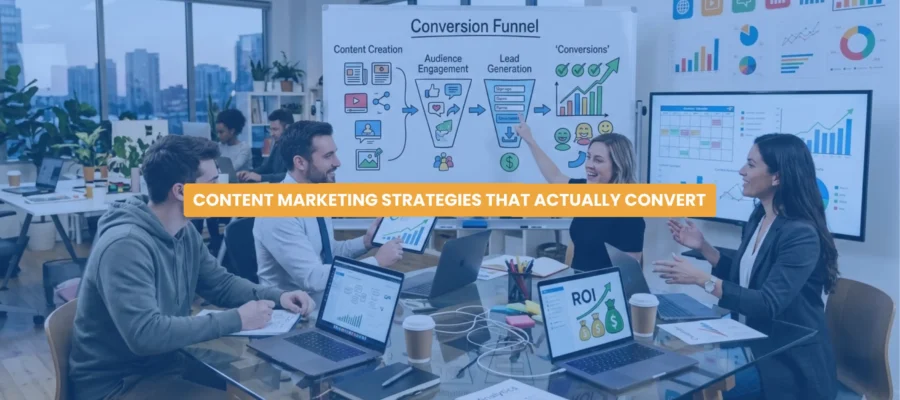
Content Marketing Strategies That Actually Convert
Every business owner has heard this before.
“You need content.”
So you post on Instagram.
You write a few blogs.
Maybe you shoot some videos.
But nothing really changes.
No serious leads.
No consistent enquiries.
No sales, you can directly connect to your content.
Here is the uncomfortable truth.
Content alone does not convert. A Content Marketing Strategy does.
And most businesses do not have one.
They are creating content randomly, hoping something works.
This blog will break down what a Content Marketing Strategy really means in 2026, what is working right now, and how you can build one that actually brings enquiries and revenue, without technical jargon.
What Is a Content Marketing Strategy in Simple Terms?
A Content Marketing Strategy is a clear plan for:
- Who you are talking to
- What problems you are solving
- What type of content you will create
- Where you will publish it
- How that content leads to enquiries or sales
That’s it.
It is not about trends.
It is not about going viral.
It is not about posting daily.
It is about direction.
If your content is not tied to business goals, it is entertainment. Not marketing.
Why Most Content Does Not Convert
Let’s be honest.
Most business content looks like this:
- “We are the best in the industry”
- “Contact us today”
- “Limited time offer”
- Random motivational quotes
- Festival greetings
None of this builds trust.
Customers in 2026 are smarter. They research before buying. They compare. They read reviews. They watch videos. They check your credibility.
Your Content Marketing Strategy must match this behaviour.
If you only talk about yourself, you lose.
If you only sell, you lose.
If you only post for consistency without purpose, you lose.
Strategy 1: Start With Customer Problems, Not Your Services
The first rule of a high converting Content Marketing Strategy is simple. Talk about their problems. Not your features.
For example:
Instead of:
“We offer digital marketing services”
Say:
“Struggling to get leads from Instagram despite posting daily?”
See the difference?
One is about you.
The other is about them.
Make a list of:
- Top 10 questions customers ask you
- Top 10 objections before they buy
- Top 10 mistakes they usually make
That list is your content plan.
When your Content Marketing Strategy answers real doubts, you automatically attract serious buyers.
Strategy 2: Educate First, Sell Later
Business owners often fear this.
“If I give too much information, why will they hire me?”
Because information is everywhere. Execution is not.
When you educate clearly:
- You build authority
- You build trust
- You reduce confusion
- You attract better quality leads
An effective Content Marketing Strategy positions you as a guide, not a salesperson.
Examples of educational content:
- “How to choose the right marketing agency”
- “3 signs your website is costing you leads”
- “What to check before investing in paid ads”
Notice something?
None of these posts are directly selling.
But they attract people who are already thinking about investing.
That is the power of a smart Content Marketing Strategy.
Strategy 3: Use Content for Every Stage of the Buyer Journey
Not everyone who sees your content is ready to buy.
Some are just discovering you.
Some are comparing options.
Some are ready to take action.
Your Content Marketing Strategy must address all three.
1. Awareness Content
This attracts new people.
Examples:
- Industry insights
- Common mistakes
- Trends explained simply
2. Consideration Content
This builds trust.
Examples:
- Case studies
- Client stories
- Behind the scenes of your process
- FAQs
3. Decision Content
This converts.
Examples:
- Clear service breakdown
- Pricing explanation
- What happens after enquiry
- Results you achieved
If your Content Marketing Strategy only focuses on awareness, you get views but no leads.
If it only focuses on selling, you get ignored.
Balance is key.
Strategy 4: Build Authority Through Consistency, Not Frequency
You do not need to post every day.
You need to post with clarity.
A powerful Content Marketing Strategy is consistent in:
- Message
- Positioning
- Tone
- Value
If today you talk about branding, tomorrow about random trends, and next week about unrelated topics, people get confused.
Clarity converts.
Decide:
- What is your core expertise?
- What do you want to be known for?
- What kind of clients do you want?
Then build your entire Content Marketing Strategy around that When people think of your service, your name should come first. That happens with focused content.
Strategy 5: Long Form Content Builds Serious Trust
Short reels are great for visibility. But long form content builds credibility. Blogs, LinkedIn articles, YouTube explanations, detailed captions. These show depth.
Search engines also prefer in depth content. That means your Content Marketing Strategy should include blogs that answer real search questions.
For example:
- “How much does digital marketing cost in Qatar?”
- “Is SEO worth it for small businesses?”
- “How to choose between paid ads and content marketing?”
When someone searches these questions and finds your blog, you gain authority immediately.
This is where SEO meets smart Content Marketing Strategy.
Strategy 6: Optimise for Search and Answers
In 2026, people do not only search on Google.
They ask AI tools.
They search on YouTube.
They use voice search.
That means your Content Marketing Strategy must be clear and structured.
To optimise for SEO and AEO:
- Use clear headings
- Answer questions directly
- Use simple language
- Avoid complicated technical terms
- Add FAQ sections in blogs
- Write in a conversational but structured way
For example:
Instead of writing complex paragraphs, answer directly.
“What is a Content Marketing Strategy?”
Then explain clearly in 3 to 4 lines.
Search engines and AI prefer clarity.
Complicated language does not make you smart. It reduces readability.
Strategy 7: Use Proof, Not Promises
Anyone can say they are the best.
Show it.
A strong Content Marketing Strategy includes:
- Before and after examples
- Client testimonials
- Screenshots of results
- Real numbers
- Real stories
People trust proof.
Even small results are better than big empty claims.
For example:
Instead of:
“We increased brand awareness”
Say:
“We helped a local business grow from 200 followers to 5,000 in six months, leading to 37 enquiries.”
Specific numbers build credibility.
Strategy 8: Clear Call to Action Matters
This is where many businesses fail.
They create content but do not tell people what to do next.
Every piece of your Content Marketing Strategy should guide the reader.
Examples of simple CTAs:
- “Book a consultation”
- “Download our guide”
- “Send us a message”
- “Visit our website”
- “Comment ‘guide’ and we will send details”
Do not assume people will figure it out.
Guide them.
Soft. Clear. Confident.
Common Questions Business Owners Ask
Is Content Marketing Strategy Better Than Paid Ads?
It is not about better or worse. Paid ads bring faster visibility.
How Long Does It Take to See Results?
If your Content Marketing Strategy is consistent and aligned with business goals, you can start seeing traction in 3 to 6 months.
But real brand authority builds over time.
Do I Need to Be on Every Platform?
No.
Choose 1 or 2 platforms where your customers are active.
A focused Content Marketing Strategy on fewer platforms works better than a scattered presence everywhere.
What Actually Converts in 2026?
Let’s simplify this.
Content that converts has:
- Clarity
- Relevance
- Proof
- Consistency
- Direction
Not trends.
Not noise.
Not random posting.
A real Content Marketing Strategy is not about creating more content. It is about creating the right content. When done correctly, your content becomes:
- Your sales assistant
- Your credibility builder
- Your lead filter
- Your brand voice
And most importantly, your growth engine.
Final Thoughts
If you feel like you are doing everything but seeing no results, pause.
Ask yourself:
Do I have a real Content Marketing Strategy, or am I just posting?
Because there is a big difference. Content without strategy creates noise. Content with strategy creates revenue. If you are serious about building authority, attracting better clients, and creating content that actually converts, it might be time to rethink your approach.
At Bragyst, we help businesses build structured, goal driven Content Marketing Strategy plans that are clear, practical, and aligned with real business growth.
If you would like to explore how this can work for your brand, you can reach out to our team and start a conversation. Sometimes the right direction is all a business needs.
Blogs

App Development in Qatar: 7 Benefits That Actually Pay Off
Performance Marketing Qatar: Why Google Ads Localization Fails
What is Cloaking in SEO?
10 Critical Signs Your WordPress Site Is Hacked in 2026 (And What to Do About It)