17-02-2026
5 Must-Have Digital Marketing Tools for Small Businesses
If you run a small business, you already know this.
Marketing is no longer optional. It is survival.
But here is the problem. Most small business owners either try to do everything manually or get overwhelmed by complicated software built for large corporations.
You do not need 20 platforms.
You do not need a full marketing team.
You need the right Marketing tools for small businesses.
Just five. The right five can help you attract customers, understand what works, and grow consistently without wasting money.
Let’s break it down clearly.
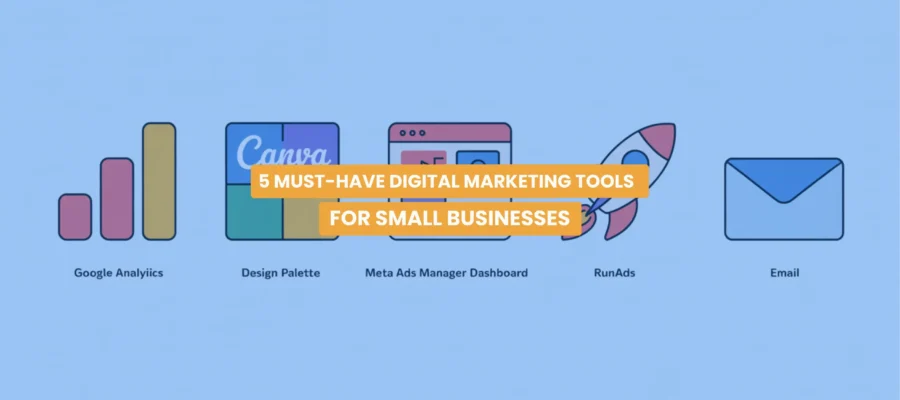
1. Google Analytics 4
If you are marketing online without tracking data, you are guessing.
Google Analytics helps you understand what is happening on your website. It shows you:
- How many people visited your site
- Where they came from
- Which pages they viewed
- How long they stayed
- Whether they filled a form or made a purchase
Why this matters: You might believe Instagram is bringing leads. Data may show Google search is performing better. Without tracking, you will continue investing in the wrong place.
This is one of the most important Marketing tools for small businesses because it replaces assumptions with facts.
Yes, it can feel technical at first. But once properly set up, it becomes your decision-making dashboard.
If you do not measure, you cannot improve.
2. Canva
You do not need to be a designer to look professional.
Canva is built for non-designers. You can create:
- Social media posts
- Flyers and brochures
- Presentations
- Website banners
- Advertisements
Small businesses often struggle with brand consistency. Fonts change. Colors change. The logo looks different every week.
Canva allows you to create a Brand Kit. You store your brand colors, fonts, and logo. This keeps everything aligned and professional.
Among Marketing tools for small businesses, Canva is powerful because visual quality directly affects trust. People judge your business within seconds.
But remember this. Good design does not replace clear messaging. A beautiful post with no strategy still fails.
Design supports marketing. It does not replace it.
3. Meta Ads Manager
Organic reach is limited. If your audience is on Instagram or Facebook, paid advertising is no longer optional.
Meta Ads Manager allows you to:
- Target specific age groups and locations
- Generate leads
- Increase website traffic
- Promote offers
- Retarget website visitors
When used correctly, this is one of the most results-driven Marketing tools for small businesses.
But here is where many business owners fail.
They boost posts randomly.
They do not define clear objectives.
They target too broadly.
They stop ads too quickly.
Paid ads are structured campaigns. They require testing, patience, and data analysis.
If you are spending money without tracking and strategy, you are not investing. You are gambling.
Used properly, this tool can generate consistent leads at a predictable cost.
4. Google Business Profile
If you serve a local audience and your Google listing is not optimized, you are invisible.
Google Business Profile allows your business to appear in Google Search and Google Maps.
When someone searches for:
- Marketing agency near me
- Bakery in Doha
- Dental clinic in Qatar
Your profile shows your location, contact details, photos, and reviews.
This is one of the most underrated Marketing tools for small businesses.
It is free.
It builds trust.
It improves local visibility.
It drives direct calls and visits.
Many businesses create their profile and never update it. That is a mistake.
Add photos regularly.
Respond to reviews.
Keep working hours updated.
Post occasional updates or offers.
Google favors active listings.
If local customers matter to you, this tool is critical.
5. Email Marketing Software
Social media platforms are rented space. Your email list is owned space.
Algorithms change. Reach drops. Accounts get restricted.
Email marketing platforms like Mailchimp or Brevo allow you to build and manage your own customer database.
You can:
- Send promotions
- Share new product launches
- Educate customers
- Drive repeat sales
For businesses focused on long-term growth, email remains one of the most cost-effective Marketing tools for small businesses.
But here is the mistake most owners make. They only send emails when they want to sell.
That approach fails.
Email should build a relationship first. Provide value. Then sell.
A small list of engaged subscribers is far more powerful than thousands of random followers.
Tools Alone Will Not Save Your Business
Here is something most people do not admit.
Tools do not grow businesses. Strategy does.
You can have every marketing tool for small businesses available. If your offer is unclear, your messaging is weak, or your targeting is wrong, nothing will work.
Tools amplify what you already have.
If your foundation is strong, they accelerate growth.
If your foundation is weak, they amplify the weakness.
That is the difference between random activity and structured marketing.
A Simple Structure for Small Business Owners
If you want to handle marketing on your own, follow this order:
- Set up tracking first.
- Define your ideal customer clearly.
- Build consistent content with clear messaging.
- Run paid ads with specific goals.
- Collect emails from day one.
Do not start with ads without a plan. That is where most budgets get wasted.
Start with clarity. Then scale.
When Should You Get Expert Help?
If you are spending money but not seeing returns.
If you do not understand your data.
If your campaigns feel random.
If you want to scale faster without costly trial and error.
That is when professional strategy matters.
Businesses searching for the Best digital marketing company in Qatar are usually not just looking for posts or boosted ads. They want measurable growth, structured campaigns, and clear reporting.
That is where Bragyst positions itself differently.
We focus on systems, performance, and long-term growth. Not hype. Not guesswork. Not vanity metrics.
Final Thoughts
Digital marketing is not complicated. It becomes complicated when there is no structure.
Focus on the right Marketing tools for small businesses. Use them correctly. Track everything. Improve consistently.
Start simple.
Be disciplined.
Measure results.
Refine based on data.
And if you decide you would rather focus on running your business while experts handle the strategy, Bragyst is ready to support you with clarity, structure, and measurable results.
Growth is not about doing more.
It is about doing the right things properly.
Blogs

App Development in Qatar: 7 Benefits That Actually Pay Off
Performance Marketing Qatar: Why Google Ads Localization Fails
What is Cloaking in SEO?
10 Critical Signs Your WordPress Site Is Hacked in 2026 (And What to Do About It)