27-07-2026
From a Bad Experience to the Right Choice: How ChatGPT Helped a Customer Find Our Client’s Business

This actually happened.
A potential client was sitting in a competitor’s office somewhere in Doha. The meeting wasn’t going well. The service felt off, the conversation wasn’t landing right, and somewhere in the middle of it, they picked up their phone and typed into ChatGPT: “best travel agency in Qatar for family holiday packages.”
RAG Tours and Travels came up in the response.
They wrapped up the meeting, walked out, and came directly to RAG’s office. By the end of that visit, they were a converted client.
We’re telling this story not to embarrass a competitor, we don’t even know which one, but because of what it demonstrates about how people are finding businesses in 2026. This client didn’t open Google. Didn’t look at a list of search results. Didn’t scroll through Instagram. They asked an AI, trusted the recommendation, and acted on it. The entire journey from dissatisfied-at-a-competitor’s-office to signed-client happened because one business showed up in a ChatGPT answer and another one didn’t.
That gap is only going to widen.
What Actually Changed in How People Search
For the last twenty years, “getting found online” meant getting onto the first page of Google. That’s still relevant. But something significant shifted in the last eighteen months and most Qatar-based businesses haven’t adjusted to it yet.
ChatGPT now has around 200 million weekly active users asking detailed, conversational questions. Perplexity, Gemini, Claude, these are all handling queries that used to go to Google. And critically, these AI systems don’t return a list of blue links for the user to scroll through. They return a synthesized answer that names specific businesses, services, and brands. Your business either gets cited in that answer. Or it doesn’t.
(The overlap between the top pages Google ranks and the sources AI engines actually cite has dropped from around 70% to below 20%.) Read that again. A business can rank on the first page of Google and still be completely absent from the ChatGPT answer that a potential client in Doha is reading right now.
That’s what happened to the competitor in this story. They may rank fine on Google. Didn’t matter. The client wasn’t on Google.
Why AI-Referred Clients Convert Differently
Here’s the part that makes GEO particularly valuable beyond just visibility.
When someone finds a business through a Google search result, they click a link, scan the site, maybe look at a few others, and eventually decide whether to reach out. Standard discovery process.
When someone finds a business through a ChatGPT response, something different has already happened. The AI has synthesized information from multiple credible sources, assessed the options, and produced a recommendation. The user who asks ChatGPT “best travel agency in Qatar for family packages” and gets a specific name mentioned isn’t getting a list to evaluate. They’re getting an implicit endorsement from a system they trusted enough to ask.
(Visitors referred from ChatGPT convert at 15.9% on average, compared to 1.76% for organic Google search.) The client who walked into RAG’s office wasn’t browsing. They were arriving. There’s a difference.
So What Is GEO, and How Does It Work?
GEO stands for Generative Engine Optimization. It’s the practice of structuring content and brand presence so that AI systems like ChatGPT, Google AI Overviews, Perplexity, and Gemini cite and recommend a business in their generated answers.
Traditional SEO optimizes for keyword rankings in a list. GEO optimizes for being the source that AI trusts enough to quote when someone asks a relevant question.
The two are related but not identical. Strong SEO creates a foundation that GEO builds on. But ranking well on Google no longer guarantees appearing in AI answers, and some businesses with strong AI citation are pages Google wouldn’t rank in the top five.
What AI systems look for when deciding what to cite:
Content that directly and completely answers the question being asked. Not content that circles the topic for eight hundred words and eventually gets to the point. An answer. Clearly structured, specific, useful.
Factual density. Citing authoritative facts, statistics, and specific details increases citation probability significantly. (Research found that fact-dense content improved AI visibility for lower-ranked pages by up to 40%.) Vague, generic content gets passed over in favour of content that actually says something.
Credibility signals. Author information. Business details. A consistent, verifiable presence across the web. How many other credible sources reference this business. AI systems are doing a version of reputation assessment when they decide who to cite.
Content structure. Content that’s organized clearly, uses proper semantic structure, and can be parsed cleanly by a machine is more likely to be extracted and cited than content that’s well-written but structurally messy.
What Qatar Businesses Need to Do Differently
The businesses in Qatar that will show up in ChatGPT answers in 2026 and 2027 are the ones building for this now, not the ones waiting to see whether it matters.
In practical terms, that means shifting from content that’s written primarily to rank for keywords toward content that’s written to genuinely answer specific questions a potential client would ask an AI. “What’s the best travel agency in Qatar for family holidays?” is a real question real people are asking. The businesses that appear in those answers have content somewhere on their digital presence that answers it well, specifically, with credibility signals behind it.
It means having a consistent, accurate business presence across the web. Name, description, services, and details that say the same thing across the website, Google Business Profile, industry directories, social profiles, and any other touchpoint an AI might be pulling from. Inconsistency confuses AI systems the same way it confuses users.
It means earning coverage and mentions from credible third-party sources. A business that’s mentioned by other credible websites, quoted in articles, featured in relevant publications, has a citation profile that AI systems take as a credibility signal. This is why digital PR and content partnerships matter in a GEO context, not just for direct traffic but for the authority signals they build.
It means tracking not just Google rankings but AI citation rate. Where does this business appear when someone asks ChatGPT about travel agencies in Qatar? What about Perplexity? Google AI Overviews? The answers to those questions right now tell a business where it stands and where the gaps are.
The Practical Starting Point
Most Qatar-based businesses we work with haven’t had this conversation yet. They’re managing social media, running Google Ads, maybe maintaining a blog. The GEO layer simply isn’t part of the brief.
The starting point is an audit: what does ChatGPT say when someone asks for the service this business provides in Qatar? What does Perplexity say? What does Google’s AI Overview surface? Those answers reveal whether the business is in the conversation or not, and what needs to change for it to get there.
The RAG client who walked in because ChatGPT cited the right business is not a one-off story. It’s an early example of a referral pattern that’s going to become much more common. The question for every Qatar business is whether they’re building toward being the name that gets cited, or whether a competitor is.
Bragyst builds GEO and SEO strategies for Qatar-based businesses, starting with understanding where a business currently sits in AI-generated answers and what it would take to be consistently cited. If that conversation is overdue, get in touch.
Blogs
App Development in Qatar: 7 Benefits That Actually Pay Off
Performance Marketing Qatar: Why Google Ads Localization Fails
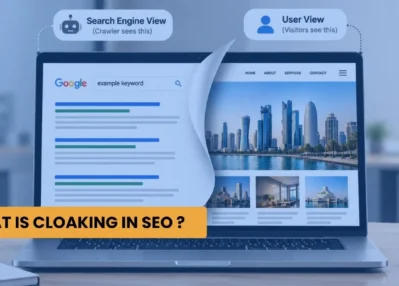
What is Cloaking in SEO?
10 Critical Signs Your WordPress Site Is Hacked in 2026 (And What to Do About It)