23-06-2026
Why GEO Is the New SEO: How to Get Your Brand Cited by AI in 2026
A client asked something a few weeks ago that’s worth repeating here. Not “why aren’t we ranking higher,” which used to be the standard opening line of basically every marketing conversation, but “does ChatGPT even know we exist.” Same general worry, completely different question, and most businesses haven’t caught up to the fact that it’s a different question yet.
SEO, at its core, is a game of getting your link into a list and hoping someone clicks it. GEO, or Generative Engine Optimization, skips the list entirely. An AI model either says your brand’s name out loud when someone asks it a relevant question, or it doesn’t, and there’s no scrollbar, no page two, no consolation prize for ranking eleventh.
The Numbers Aren’t Subtle Anymore
ChatGPT hit 900 million weekly active users by February 2026, per OpenAI’s own reporting. That’s more than double what it was a year earlier. Around the same time, Gartner put out a projection that traditional search volume would drop by roughly a quarter as people shift a chunk of their queries from Google into chat windows instead. Two numbers, same story, told from opposite ends.
Here’s the one that actually stopped me mid-scroll when we came across it. Ahrefs found that a sizeable chunk of the pages ChatGPT cites most often don’t show up in Google’s organic results at all. Zero visibility. And going the other direction, fewer than one in ten sources cited across ChatGPT, Gemini, and Copilot rank in Google’s top ten for that same query. Ranking and getting cited have split into two separate games. A lot of companies are playing only one of them and assuming it covers both.
Why Good SEO Doesn’t Just Carry Over
None of this means SEO fundamentals stop mattering, backlinks and clean site architecture still count for something. But an AI engine isn’t browsing a page looking for a spot to drop a link. It’s lifting a chunk of text it can quote cleanly, attach a source to, and drop into an answer next to two or three other chunks pulled from somewhere else. That’s a different writing job than ranking copy.
There was a study out of Princeton, Georgia Tech, and the Allen Institute for AI back in 2024 (presented at KDD, for anyone who tracks that sort of thing) that tested this across thousands of queries. Pages with actual statistics, direct quotes, and named citations got pulled into AI answers far more often than pages making the same claims without any of that backing. The model isn’t grading on confidence. It’s looking for something it can point to.
Same logic applies to how consistently a brand shows up across the web. Same name, same description of what the company actually does, repeated across the website, directory listings, review sites, wherever else it gets mentioned. A model has an easier time trusting something it can verify in three places than something it only finds once, on the brand’s own homepage, written in marketing language.
Everyone’s About to Make the Same Mistake
Half the guides floating around right now boil down to “add an FAQ section to every page.” Fine advice, except when every competitor in a category reads the same guide and does the same thing in the same month, the result is a pile of nearly identical FAQ blocks all fighting for the same handful of citation slots.
What actually works is less mechanical and harder to fake. Original data nobody else has published. A point of view stated plainly instead of hedged into mush. Writing that sounds like someone who actually knows the subject, not a template with the blanks filled in. A model built to sound credible tends to gravitate toward things that already read as credible before it got there.
What This Actually Means for Qatar
Most businesses running SEO services in Qatar campaigns right now are pouring effort into a channel that’s shrinking, while the GEO side sits almost untouched. Type “best digital marketing services Qatar” into ChatGPT today and there’s a decent chance the answer is thin, generic, or just wrong, because almost nobody in this market has built content with AI citation in mind yet. That gap doesn’t stay open forever. Once a few brands in a category lock in citation preference, prying it loose later costs a lot more than claiming it early.
Bragyst has been folding this into how SEO services in Qatar get planned for clients, treating SEO and GEO as one strategy instead of two separate budget lines, anchored in real data and consistent brand signals across the platforms a model actually pulls from. Getting found by a person searching and getting named by a machine answering aren’t the same task anymore. Whoever sorts that out first in a given category in Qatar is going to be hard to dislodge by 2027.
Blogs
App Development in Qatar: 7 Benefits That Actually Pay Off
Performance Marketing Qatar: Why Google Ads Localization Fails
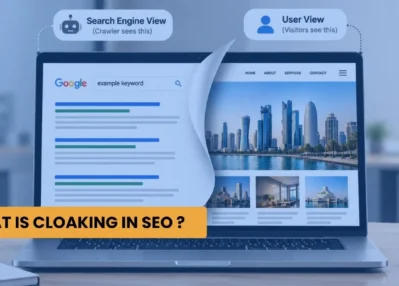
What is Cloaking in SEO?
10 Critical Signs Your WordPress Site Is Hacked in 2026 (And What to Do About It)