30-05-2026
Qatar Businesses Are Losing Sales Every Night. An E-commerce Website Is Why.

If your Qatar business is still taking orders through Instagram DMs or a WhatsApp number, you are not running an e-commerce business. You are running a manual operation dressed up to look like one. And there is a real cost to that, it is just one you cannot easily see on a spreadsheet.
Every message that came in at midnight and sat unanswered until morning. Every customer who asked “is this available?” and did not get a reply fast enough and bought from someone else. Every Ramadan week where your team was overwhelmed and orders slipped through because there was no system holding them.
That cost is real. It compounds quietly. And in Qatar in 2026, it is entirely avoidable.
Qatar’s Online Shoppers Are Not Waiting For You to Catch Up
Here is what the market looks like right now, plainly.
Qatar has internet penetration above 99%. The population earns more per capita than almost anywhere else on earth. Roughly 88% of residents are expatriates who arrived already used to buying everything online, from groceries to furniture to fashion. They are not being introduced to e-commerce. They are looking for local businesses that can meet a standard they already have.
And here is the part that matters for timing: Qatar’s e-commerce market is still less crowded than Saudi Arabia or the UAE. That gap is closing. Businesses building a proper online presence now are doing it before their category gets saturated, not after.
The window exists. It will not stay open in the same way for much longer.
What an E-commerce Website Actually Does That Nothing Else Can
Let me be specific here because “you need a website” is advice so vague it has stopped meaning anything.
It sells at hours your team cannot work. Qatar’s shopping behaviour does not follow a 9 to 5 pattern. Ramadan flips the entire clock, people are browsing and buying late at night for weeks. Summer means half your regular customers are abroad but still willing to order for when they return. An e-commerce website is open at 2am on a Tuesday without anyone on your team doing anything. A WhatsApp number is not.
It removes the steps that kill the sale. Think about what buying through Instagram actually asks of a customer. Message to ask about availability. Wait. Get a payment link. Transfer money manually. Wait again for confirmation. That is four separate moments where the customer can lose interest, get distracted, or find someone who makes it easier. A proper checkout collapses all of that into a single flow that takes two minutes. The fewer steps between wanting something and owning it, the more sales you close. This is not a theory. It is just how buying behaviour works.
It tells you things your physical shop never could. Which products people looked at but did not buy. Which page they were on when they left. Where they came from before they landed on your site. What device they were using. At what point in checkout they stopped. None of this is surveillance for its own sake. It is the information that tells you exactly where you are losing people and what to fix. Running a business without it is like driving at night with the headlights off. You can do it, but you are guessing at everything.
It makes every riyal of marketing spend go further. Running paid ads on Instagram or Snapchat without a proper website to land on is one of the most consistent ways to burn a budget without results. The traffic shows up and there is nowhere for it to go that converts properly. A product page built to answer objections, a checkout that does not intimidate, retargeting that follows up with people who visited but did not buy. All of this requires a website. Without one, your ad spend is working at maybe half the efficiency it could be.
The Qatar-Specific Things Generic Advice Always Misses
Most e-commerce content is written for Western markets and ported across with minor edits. It misses things that genuinely matter here.
Snapchat is not a minor platform in Qatar. In most Western markets it barely registers as a marketing channel. In Qatar, particularly for reaching Qatari nationals and younger Arab consumers, it is significant. An e-commerce marketing strategy for Qatar that ignores Snapchat is already incomplete.
Arabic content is not optional, it is revenue. Qatari consumers search in Arabic. A website and product pages that only exist in English are invisible to a portion of the market that has purchasing power. This is not about translation as a gesture. It is about showing up where people are actually searching.
Ramadan is not just a period of lower activity. For some categories it is the highest revenue period of the year. Shopping behaviour shifts to late night hours, gifting drives major purchase decisions, and certain product categories spike sharply. Businesses without an e-commerce setup miss this almost entirely. Businesses with one, and a marketing plan built around it, often do more in those four weeks than in the two months surrounding them.
The expat churn cycle creates constant new demand. Qatar’s expatriate population turns over regularly. People arrive, set up a home, discover local brands, and buy. People leave, replaced by new arrivals who go through the same process. An e-commerce website that ranks in search captures this cycle passively. A business that relies on word of mouth and Instagram followers loses a chunk of its audience every time a wave of expats relocates.
What E-commerce Marketing in Qatar Looks Like When It Works
Building the website is the beginning, not the end. What actually drives revenue is what happens after it launches.
Search is the channel that compounds. When someone in Qatar searches “buy modest wear online Doha” or “home gym equipment Qatar delivery,” they are telling you exactly what they want and they are ready to buy it. A website that appears for those searches captures demand that already exists. It does not have to create it. SEO takes time to build but unlike paid advertising it does not stop working when the budget runs out.
Paid social needs to land somewhere that converts. Instagram and Snapchat ads work in Qatar. The audience is there, the purchasing power is there, the behaviour is there. But the ad is only ever as good as the page it sends people to. A well-targeted ad landing on a product page built to convert is a completely different equation to the same ad pointing at an Instagram profile.
Retargeting is where a lot of the money actually is. Most first-time website visitors do not buy. That is not failure, that is just how shopping works online. Retargeting follows those visitors across Instagram, Facebook, and Google and reminds them of what they looked at. For Qatar’s market specifically, where the purchasing power is high and the decision often just needs a second touchpoint, retargeting return on ad spend tends to be strong.
WhatsApp marketing belongs in this picture too. Qatar is a WhatsApp-first country. A business that captures customer contacts through its website and communicates with them directly through WhatsApp broadcasts has a channel that does not cost per impression and does not depend on an algorithm. New product drops, seasonal promotions, restock alerts. All of it lands in a place people actually check.
Who This Is Really For
Not every business needs to go from zero to a fully built e-commerce operation overnight. But if any of these describe you, the conversation is worth having sooner rather than later.
You are selling products through Instagram DMs or WhatsApp and the manual work is becoming unsustainable as volume grows. You have a physical shop in Qatar and want to capture the customers who will never walk in but would buy online. You are running paid ads and not getting the return you expected because the landing experience is not converting. You launched a website but it gets traffic and does not sell anything meaningful.
These are all fixable problems. They are just easier to fix with the right support than by trial and error.
Where Bragyst Comes In
Bragyst is a digital marketing agency in Qatar. The work covers e-commerce strategy, website development, SEO, paid social advertising, content, and the ongoing optimisation that turns a website that exists into one that generates consistent revenue.
The businesses that get the most from e-commerce marketing in Qatar are not always the ones with the biggest budgets. They are the ones that get the strategy right from the beginning: right platform, right product presentation, right channels for their specific audience, and consistent execution behind it. That is what Bragyst is built to deliver.
If you are thinking seriously about e-commerce, or you already have something that is underperforming, that is exactly where the conversation starts.
Talk to Bragyst about e-commerce marketing in Qatar. First consultation is free.
The Honest Summary
Qatar is one of the better markets in the world to sell online right now. High income, high digital adoption, growing e-commerce infrastructure, and still less competitive than the UAE or Saudi Arabia in most categories.
The businesses that move properly in the next twelve to eighteen months are going to own positions in their categories that will be significantly harder and more expensive to claim later. That is not hype. That is just how digital markets develop.
An e-commerce website is not a luxury for a Qatar business in 2026. It is the thing that determines whether your marketing spend converts or evaporates, whether you capture demand at midnight or lose it to someone who does, and whether you have any real data to grow from or are still running on gut feel and Instagram analytics.
Bragyst helps Qatar businesses build and market e-commerce properly. If that is a conversation worth having, now is a good time to have it.
Contact Bragyst today. Free consultation on e-commerce marketing in Qatar.
Blogs
App Development in Qatar: 7 Benefits That Actually Pay Off
Performance Marketing Qatar: Why Google Ads Localization Fails
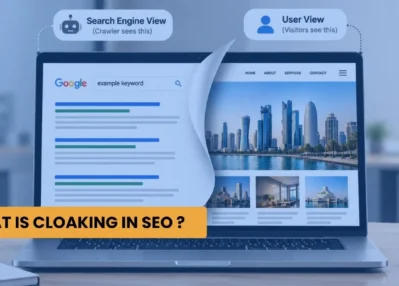
What is Cloaking in SEO?
10 Critical Signs Your WordPress Site Is Hacked in 2026 (And What to Do About It)