09-05-2026
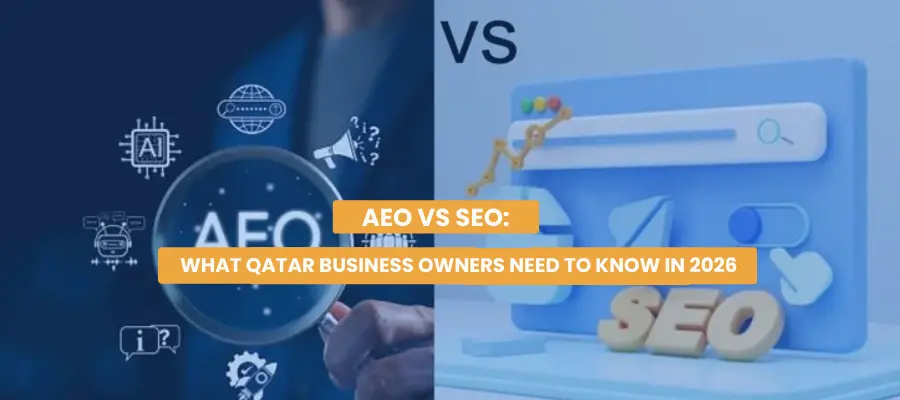
AEO vs SEO: What Qatar Business Owners Need to Know in 2026
A cafe owner in Doha spent months getting his website to page one on Google. Good content, proper keywords, consistent effort. He got there.
Then the calls didn’t come.
What happened? People were searching, Google was showing results, but right above those results, an AI box was already answering the question. “Best cafe near me in Doha.” Google read a few websites, pulled the most useful answer, and displayed it directly. No click needed. His page-one ranking was technically correct. It was also largely invisible.
This is the gap between SEO and AEO. And for Qatar businesses in 2026, understanding the difference is becoming genuinely important.
What SEO Actually Does
Search Engine Optimization is what most businesses in Qatar have been doing, or trying to do, for the past several years. The goal is simple: get your website to appear high up in Google’s results when someone searches for something relevant to your business.
SEO involves things like keyword research, building quality backlinks, making sure your website loads fast, optimising your Google Business Profile, and creating content that Google’s crawlers can read and understand. Done well, it drives a steady flow of traffic to your website over time. It’s a long game, but it works.
The problem isn’t that SEO stopped working. It’s that the search results page itself changed.
Ahrefs found that position-one click-through rates drop 58% when an AI Overview is present in the results. That means a business that worked hard to reach the top of Google can now lose more than half its expected clicks simply because an AI box appeared above them and answered the question before anyone scrolled down. Traffic that used to flow to websites is increasingly staying on the results page. Emerhub
So SEO is still the foundation. But it’s no longer the whole picture.
What AEO Is and Why It’s Different
Answer Engine Optimization is newer. The goal isn’t to rank a page, it’s to become the answer itself.
When someone asks Google “which salon in Lusail is open now?” or tells their phone “find me a travel agency for Eid packages in Qatar,” they’re not always looking to browse ten websites. They want a direct answer. Google AI Overviews, ChatGPT, Perplexity, Gemini, these systems read through available content and synthesise a response. The businesses whose content is structured clearly enough to be understood and extracted by these systems are the ones that get cited.
AEO emphasises structured data like schema markup, FAQ formats, featured snippets, and content that AI language models can easily summarise and present to users rather than driving people to a website. The distinction matters because over 400 million people now use ChatGPT each week to find information, in addition to Google AI Overviews, Perplexity, and voice assistants. That’s a significant portion of search happening in places where traditional SEO rankings don’t apply. Jarnias CyrilNewoon
Think of it this way. SEO is about being on the list. AEO is about being the answer.
What This Looks Like for Qatar Businesses Specifically
Qatar has a search behaviour pattern that makes AEO particularly relevant here.
Voice search is genuinely dominant. People search in Arabic and English, often switching between both in the same query. “مندي الريان مطعم” and “best mandi restaurant Al Rayyan” are both real searches, often from the same customer base. Voice queries are conversational by nature, they’re full questions, not just keywords, and that’s exactly the format AEO is built to answer.
Local intent searches, “open now near me,” “ladies salon Lusail today,” “Eid Dubai packages Qatar”, are extremely common here and they trigger AI-generated answers constantly. A restaurant that hasn’t structured its content to answer “are you open for iftar?” clearly and specifically is invisible to those answer boxes, regardless of where its website ranks.
There’s also the zero-click reality. Bain & Company reports that 80% of consumers rely on zero-click results for 40% of their queries. That doesn’t mean those interactions have no value. A customer who sees your restaurant cited as the answer to “best biryani near West Bay” has already formed an impression of your business before they ever visit your website. The click comes later, when they’re ready to book or call.
So Do You Need SEO or AEO?
Both. And this is where a lot of the online conversation gets unnecessarily confusing.
SEO is still the infrastructure layer. AEO is the layer that adapts that infrastructure for answer-first environments. You can’t have effective AEO without solid SEO underneath it, the AI systems that generate answers can only read and extract content from websites they can find and crawl in the first place. A website with poor technical SEO is essentially invisible to AI answer engines too. Agentsgrp
But a website with great SEO and no AEO structure is increasingly losing ground to competitors whose content is easier for AI systems to extract and cite.
The practical difference shows up in how you create content. SEO-focused content tends to be comprehensive, long-form, and built around keyword placement. AEO-focused content prioritises short, direct answers to specific questions, ideally within the first paragraph of each section, before any elaboration. FAQPage schema markup tells Google explicitly that a piece of content is structured as questions and answers, making it far easier for AI systems to pull those answers into overviews and voice responses.
In SEO, the goal is Position 1. In AEO, the goal is to be the source citation. For most Qatar businesses, the winning position in 2026 is ranking on page one AND being the cited answer in AI overviews. That combination is harder to achieve but far more durable than either approach alone.
What Good AEO Content Actually Looks Like
The shift isn’t as dramatic as it sounds.
The best AEO content still reads naturally. It’s not a list of robotic FAQ pairs. It’s well-written content that happens to answer specific questions clearly and early, uses structured data in the background, and covers a topic thoroughly enough that an AI system summarising it would have everything it needs.
For a Qatar restaurant, that means your website content should directly answer questions like “are you open during Ramadan?”, “do you offer private dining?”, and “what cuisine do you specialise in?”, not buried in a paragraph on your About page, but clearly, near the top, in plain language.
For a travel agency, it means content that answers “what documents do I need for a Dubai visa from Qatar?” or “what are the best Eid travel packages from Doha?” with a direct, specific response before expanding into detail.
For a salon, it means answering “do you take walk-ins?” and “what are your ladies-only hours?” in a way that Google can pull and display without the customer needing to visit your site.
None of this is technically complex. Most of it is just clear writing combined with the right schema markup in the background, which is where the technical side of AEO comes in.
Where Bragyst Comes In
Most Qatar businesses are still running an SEO-only strategy in a search environment that has already moved on.
70% of marketers believe AEO will significantly impact their digital strategy within one to three years, but only 20% have begun implementing it. That gap is an opportunity for Qatar businesses willing to move now. QCF Global Services
Bragyst builds SEO and AEO strategies together, structured content that ranks on Google and gets cited by AI, schema markup that puts your business in voice search answers, and Arabic-English optimisation built for how Qatar customers actually search.
If you want to know where your business stands today, we offer a free AEO audit. Get in touch and we’ll show you exactly what you’re missing and what it’s costing you.
Blogs
App Development in Qatar: 7 Benefits That Actually Pay Off
Performance Marketing Qatar: Why Google Ads Localization Fails
What is Cloaking in SEO?
10 Critical Signs Your WordPress Site Is Hacked in 2026 (And What to Do About It)